




07 de July de 2026
Dinamización rural
Resiliencia y competitividad
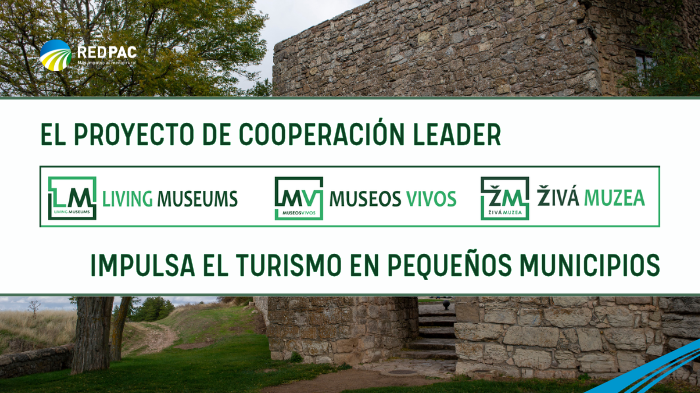
“Living Museums” is a LEADER cooperation project in which 18 Local Action Groups from Castilla y León participated, and two museums in Galicia and one in the Czech Republic joined.
- “Living Museums” is a LEADER cooperation project in which 18 Local Action Groups from Castilla y León participated, and two museums in Galicia and one in the Czech Republic joined.
- This network of museums provides small municipalities with a low-cost tourism option managed through new technologies.
Rural Spain boasts numerous ethnographic museums, nature interpretation centers, and cultural spaces that represent a significant resource for rural tourism. These centers, particularly in smaller municipalities, attract visitors while simultaneously preserving and promoting their heritage.
Faced with the closure of some of them, six Local Action Groups (LAGs) from Castilla y León joined together in 2018 to find a solution that would allow them to reopen at a low cost, and thus the LEADER cooperation project “ Living Museums ” was born, which was later joined by other LAGs and, in collaboration, two museums from Galicia and one in the Czech Republic.
Technology and digitization to reopen rural museums
The Local Action Groups (LAGs) decided to find an innovative solution that would allow visitors year-round access with extended hours. To achieve this, they implemented a smart access system. Visitors make a reservation in advance through the website and receive an access code that must be entered on a digital keypad at the museum entrance to open it for 30 minutes or an hour. This way, the centers are open 24 hours a day, every day of the year, without time restrictions or staff limitations. To enhance the visit, they also offer brochures and audio guides. All reservations are made centrally through the "Living Museums" website , which includes a list and a map of all participating museums by region.
Impact on rural territories
The project coordinator, Eugenio García-Rojo, explains that the advantage of cooperation “is that it allows us to find joint solutions to common problems” faced by all the participating municipalities. “Starting in 2010, the economic crisis meant that the town councils could no longer afford to keep the staff at these museums, and many ended up closing.”
Eugenio explains that the "Living Museums" system has addressed this and other challenges of rural depopulation, such as the reopening of churches , both as cultural sites and for religious services, and castles , thus highlighting new artistic and architectural elements. It also promotes tourism in depopulated municipalities, helping to keep other businesses in sectors like hospitality open.
Results of “Living Museums”
Currently, the project comprises 89 museum sites in Castile and León, two in Lugo (Galicia), and one in the Czech Republic (in the Central Bohemian Region). Thematically, most are ethnographic, cultural, environmental, and historical heritage sites; however, castles and churches, as well as archaeological and geological museums, are also included.
By the end of 2025, the project had attracted 305,382 visitors to the museums and over three million visits to its website. It was a finalist for the Rural Inspiration Awards (RIA) in 2022 and the Europa se Siente Awards in 2023.
In March 2026, the project participated in the Red PAC: LEADER cooperation conference , where Eugenio García-Rojo stated that thanks to their participation they established contacts with new territories and countries such as Italy, Portugal, Romania or Bulgaria to collaborate on joint actions.
Participants and funding
During its first phase (2018-2022), “Living Museums,” coordinated by ADRI Valladolid Norte , involved 15 Local Action Groups (LAGs) in Castile and León, with more than 80 spaces open to the public in various municipalities. It was subsidized 80% by the European Agricultural Fund for Rural Development ( EAFRD) through the LEADER approach , 14% by the Regional Government of Castile and León , and 6% by the Ministry of Agriculture, Fisheries and Food .
Currently, the third phase, Living Museums+, is being processed by the Regional Government of Castile and León. Eighteen Local Action Groups (LAGs) from Castile and León will participate in this phase and will continue collaborating with other regions. ADRI Valladolid Norte estimates that it will be approved “shortly.”