





15 de June de 2026
Innovación
Cambio climático y gestión de recursos naturales
Resiliencia y competitividad
Food sovereignty and genetic innovation are at the heart of the international debate in the seed sector
Food sovereignty and genetic innovation are at the heart of the international debate in the seed sector
Lisbon hosts the main global forum analyzing the strategic role of seeds in the agri-food sector
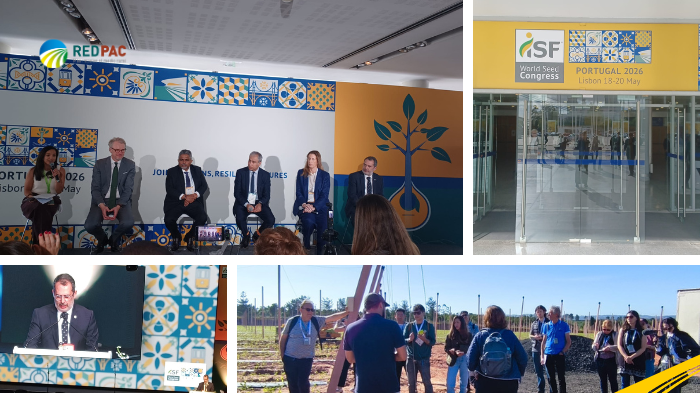
Seeds are the foundation of agricultural production and a key element in ensuring food security and sovereignty in Europe, as well as driving innovation in the sector. With this focus, the CAP Network participated in the 2026 World Seed Congress , held from May 18 to 20 in Lisbon, one of the leading international gatherings for the seed industry.
Organized by the International Seed Federation ( ISF ), the Congress brought together companies, policymakers, the scientific community and industry stakeholders to discuss the future of agriculture, the resilience of agri-food systems and the role of innovation in food production on a global scale.
Seeds, a strategic axis of food security and sovereignty
The participation of the CAP Network in this international forum is framed within the fundamental role of seeds within the Common Agricultural Policy ( CAP ), which has among its objectives to guarantee a stable food supply, support farmers, strengthen rural development and protect the environment.
In an international context marked by geopolitical and climate uncertainty, the European Union (EU) has reinforced its commitment to food security , considered an essential pillar of European strategic sovereignty.
In this context, seeds are becoming a key resource for improving productivity, adapting to climate change, and preserving agricultural diversity. Furthermore, they play a central role in food sovereignty , helping regions to guarantee their production capacity and access to quality food through sustainable systems.
New genomic techniques: innovation for a more resilient agriculture
Another central theme of the Congress has been the advancement of new genomic techniques ( NTG ) , considered a key tool for the future of the European agri-food sector.
In 2023, the European Commission (EC) presented a proposal to regulate these techniques, which allow the development of more resilient, resource-efficient plant varieties that are better adapted to the effects of climate change.
Furthermore, in 2025 the Council and the European Parliament reached an agreement to move forward with a specific regulatory framework that will facilitate its development, strengthen the sustainability of the food system and contribute to EU food security.
This process, closely linked to innovation and digitalization The transfer of knowledge through the AKIS system already places plant genetic improvement at the center of future European agricultural policies.
Social rights in the value chain
In this context, the Congress also served as a platform for the International Seed Federation (ISF) to launch new “Practical Guidelines on Social Rights in Seed Production ,” a voluntary framework aimed at companies, suppliers, and producers to strengthen responsible labor practices throughout the value chain. These guidelines, aligned with international standards such as those of the Organisation for Economic Co-operation and Development ( OECD ) , the United Nations ( UN ) , and the International Labour Organization ( ILO ) , promote key aspects such as decent work, job security, non-discrimination, and respect for rural communities.
With this, the seed sector takes another step towards sustainable production that integrates innovation, food safety and social responsibility, in line with the CAP objectives and disseminated by the PAC Network.
A global space for the future of the agricultural sector
The World Seed Congress 2026 is thus consolidated as a strategic forum to discuss the main challenges of the agri-food system: from food security and sovereignty to genetic innovation, including economic, environmental and social sustainability.
The participation of the CAP Network reinforces its role as a platform for the exchange of knowledge and good practices, aligned with the objectives of the CAP and with the debates on its future beyond 2027.
To delve deeper into these topics, you can consult our publications .